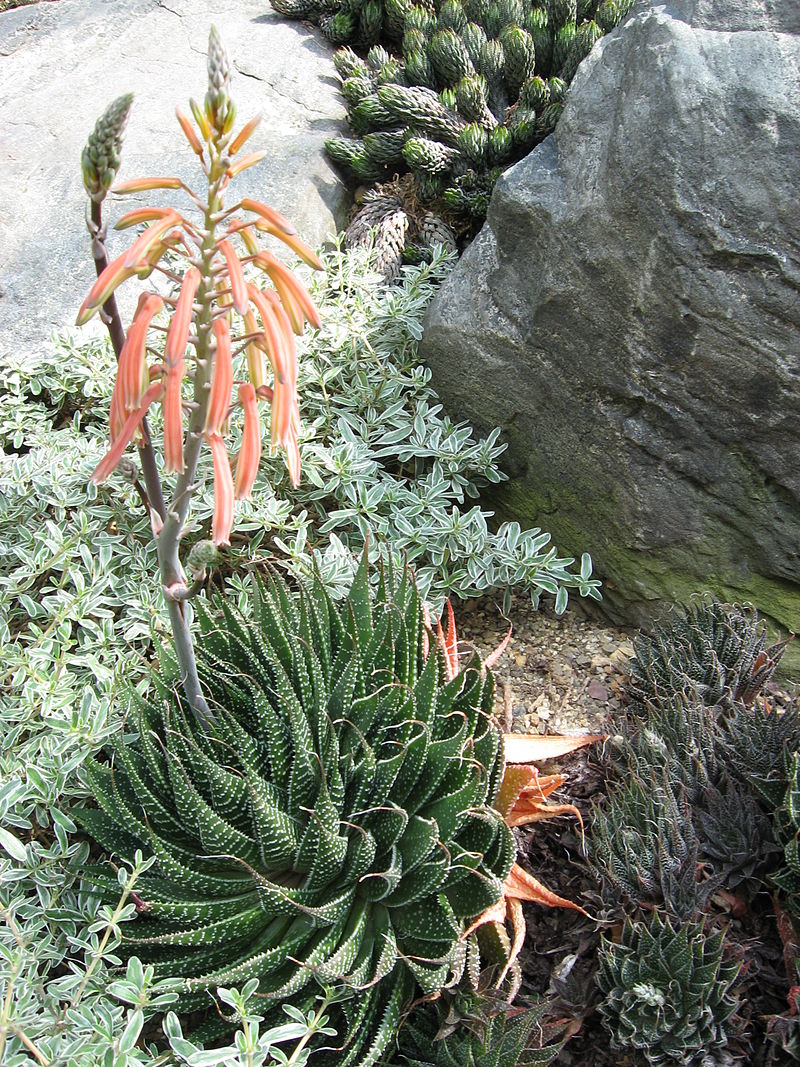


It is stemless, sawtoothed and succulent. The soft succulent leaves grow in rosettes, and are lanceolate with bristly margins.
Its nectar-rich, tubular orange flowers tend to attract birds, bees, and wasps easily. When not in bloom, it is similar to and often confused with some other species, such as Haworthiopsis fasciata.
It is indigenous to South Africa and Lesotho. Its natural range extends from the Karoo region of the Northern Cape and Eastern Cape Provinces of South Africa, eastwards through the Orange Free State and Lesotho, as far as the borders of Kwazulu-Natal Province.
Within such a wide range, this adaptable little species inhabits a range of environments, from the dry, sandy Nama Karoo, to the high grasslands and cold mountain slopes of Lesotho, and the shady forested valleys of KwaZulu-Natal.
It is commonly cultivated as a garden plant around the world. It prefers well-drained soils, but can tolerate a range of rainfall systems. It can also tolerate temperatures down to -7 °C, due to its adaptation to cold mountain tops. However it may need to be grown indoors or under glass in extremely cold temperate regions, to give it some winter heat. This clumping species readily produces large numbers of off-sets, which can be separated and planted as a means of propagation.
It has gained the Royal Horticultural Society's Award of Garden Merit.
For more information, find sourse: https://en.wikipedia.org/wiki/Aristaloe