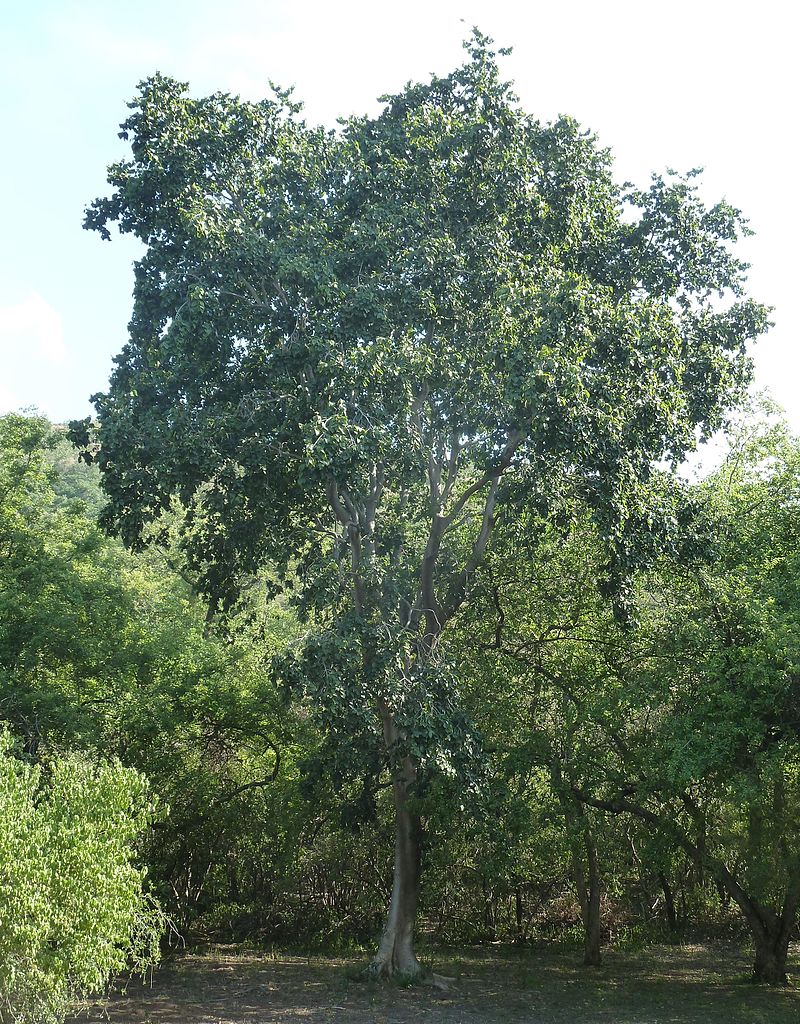


Growing as an individual tree in the open and under favourable conditions, Celtis africana becomes a tree of medium height, typically up to 12 m or so. It then usually forms a dense, hemispherical canopy. The bole of a mature tree then is thick and buttressed, often forked fairly near the ground. In forest it may grow up to 25 m tall, with a single, clean bole, though such large specimens usually are more or less buttressed too. In an exposed, rocky position it may be a bonsai-like small shrub. The trunk has a smooth, pale grey to white bark that may be loosely peeling in old trees and commonly has horizontal ridges.
The tree is deciduous in the drier, frostier interior of its range in Africa, but semi-deciduous nearer the coast; in areas with wetter, milder winters it commonly retains its old leaves till after the spring leaf-flush appears. In spring it produces light green, tender, new leaves that contrast with the pale bark. The leaves are simple, alternate, ovate to acuminate in shape with three distinct veins from the base. The leaf margin is slightly toothed (specifically serrate) towards the apex, whereas the basal third tends to be entire. The new leaves are bright, fresh green and hairy on the upper surface; they turn darker green and become smoother as they mature. (Leaf size: 15 to 100 mm length x 10 to 50 mm breadth).
The trees' small flowers are pale yellow in colour, and appear from August to October. Their fruit are carried on long, thin stalks. They are yellow or brown in colour and about 4 mm in diameter.
For more information, find source: https://en.wikipedia.org/wiki/Celtis_africana