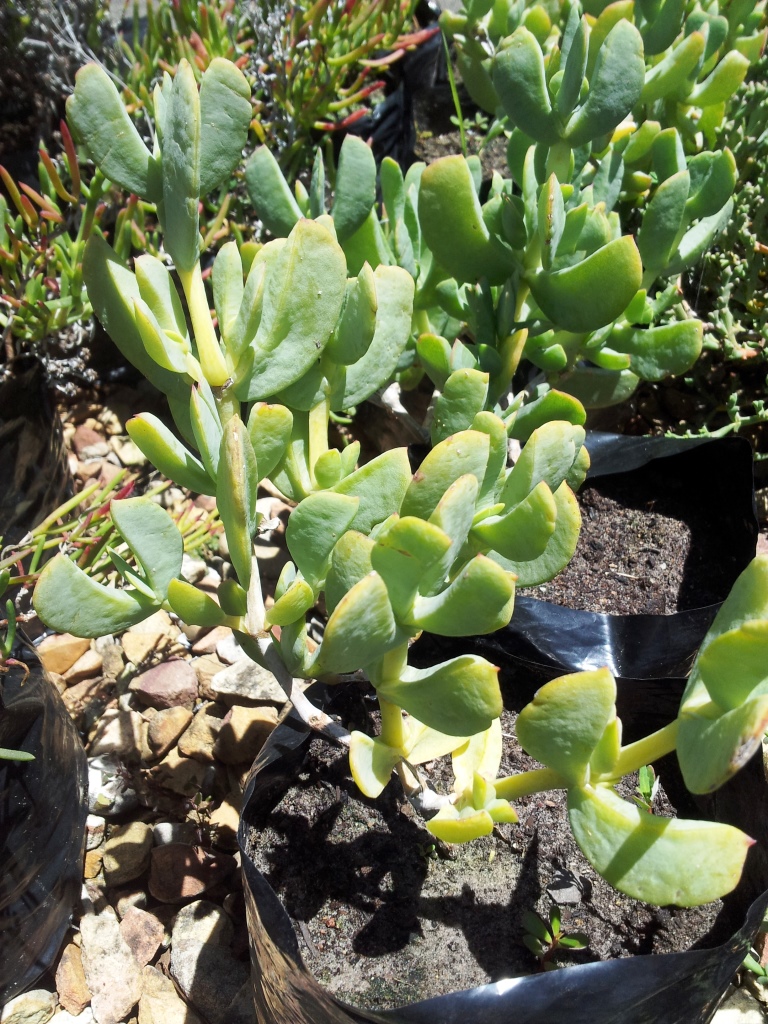


This large erect perennial shrub can spread more than 1 m. The branches are woody and tough with short internodes. It also has very large, opposite, three-sided leaves with a reddish tint on the leaf tips.
Flowers are small with purple petals with a cone of stamens. When flowering, the plant is covered in sweet-scented flowers. Flowering can take place at any time of the year, but most Ruschia species flower from September to November. Mature fruits of this plant are small, hard and contain 4 or 5 locules.
Ruschia maxima occurs in the Western Cape near the coast and inland towards Clanwilliam and the Bobbejaansberge, at altitudes of 300-800 m. Many specimens have been found on north-facing slopes and they can tolerate rainfall ranging from less than 100 mm to 800 mm per year. Ruschia maxima can tolerate frost and fires. It is found in different habitats and grows in all kinds of soil, derived from sandstone, quartzite, clay and shale. The genus Ruschia is widespread in South Africa and occurs in summer rainfall regions too.
Ruschia was named after a farmer, Mr. Ernst Rusch, of the farm Lichtenstein, near Windhoek (Namibia). There are more or less 51 species in this genus. Ruschia can easily be mistaken for Lampranthus or Drosanthemum, which all fall under the same family, Mesembryanthemaceae (Aizoaceae). Lampranthus and Drosanthemum& nbsp;have much bigger flowers and a wider colour range than Ruschia . Ruschia maxima, however, is the largest amongst the Ruschia species.
Visit site for more information: http://pza.sanbi.org/ruschi a-maxima