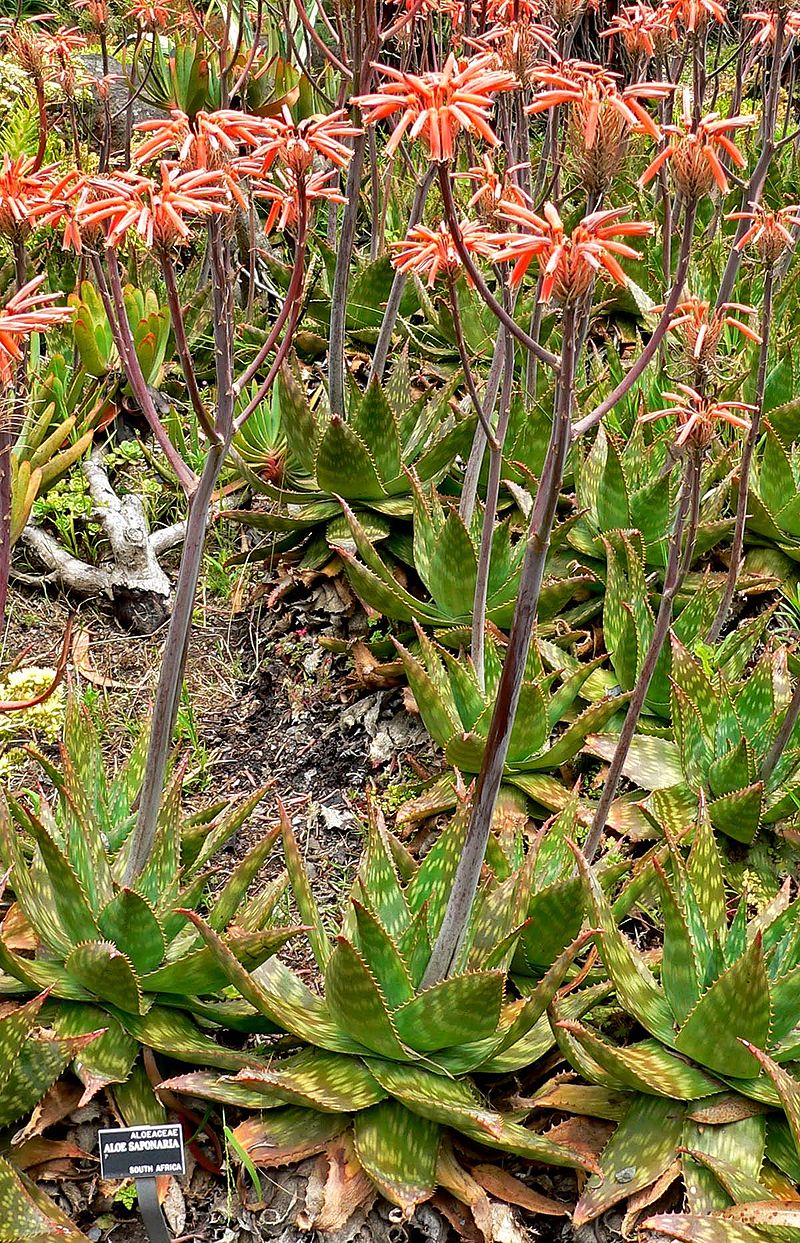


It is a very variable species and hybridizes easily with other similar aloes, sometimes making it difficult to identify. The leaves range in colour from red to green, but always have distinctive "H-shaped" spots. The flowers are similarly variable in colour, ranging from bright red to yellow, but are always bunched in a distinctively flat-topped raceme. The inflorescence is borne on the top of a tall, multi-branched stalk and the seeds are reputedly poisonous.
This species was previously known as Aloe saponaria (a name that came from the Latin "sapo" meaning soap, as the sap makes a soapy lather in water). Its currently accepted name, according to the South African National Biodiversity Institute (SANBI), is Aloe maculata ("maculata" means speckled or marked).
Taxonomically, it forms part of the Saponariae series of very closely related Aloe species, together with Aloe petrophila, Aloe umfoloziensis, Aloe greatheadii and Aloe davyana.
The soap aloe is highly adaptable and is naturally found in a wide range of habitats across Southern Africa, from Zimbabwe in the north, to the Cape Peninsula in the south. Specifically, it is native to southern and eastern South Africa, south-eastern Botswana and Zimbabwe.
In addition, it is now planted around the world as a popular landscape plant in warm desert regions – especially in the United States, where it is the most popular ornamental aloe in the Tucson, Arizona area, and is also popular in California.
This plant gel is used traditionally as a remedy for many medicinal properties by local people like: Skin complains, inflammation, respiratory system, muscular-skeletal system, poisoning, circulation and endocrine system diseases.
View source for more information: https://en.wikipedia.org/wiki/Aloe_maculata