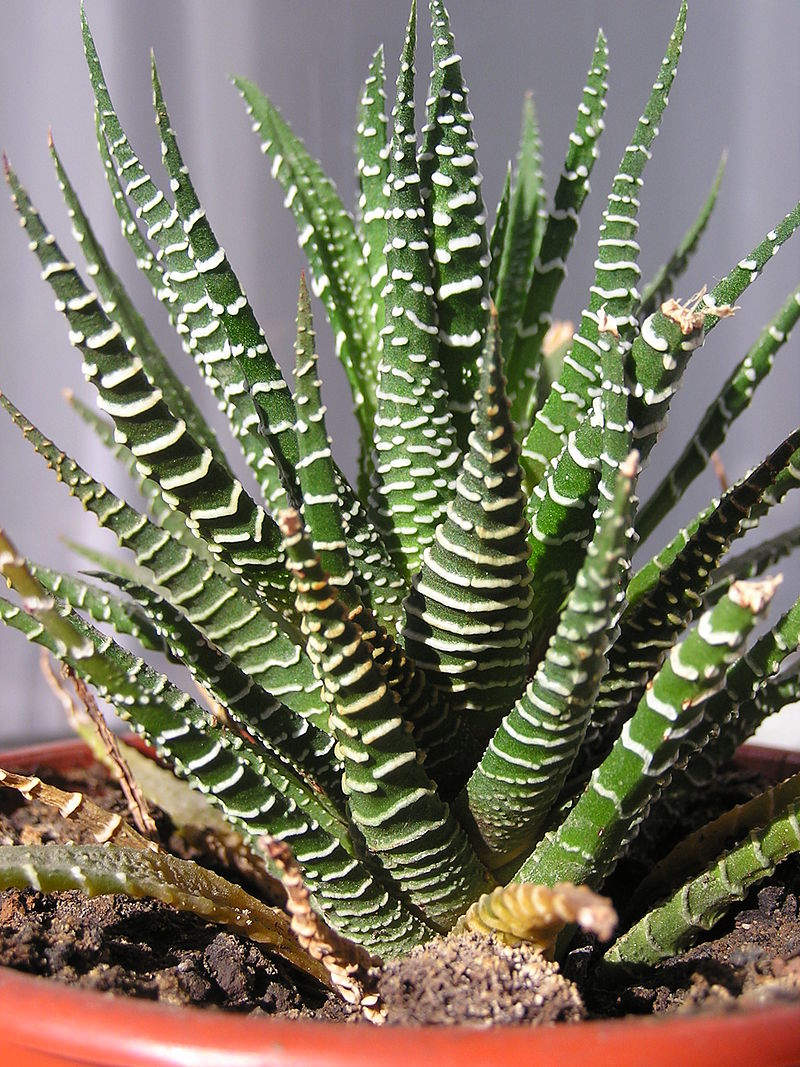


Haworthiopsis species are short perennial plants, with or without an obvious stem. The leaves either form a rosette or are arranged in a spiral on a more extended stem. Individual leaves are smooth or have white markings, which may take the form of small protuberances (tubercules) or be more pointed, almost spine-like. The white markings may be on the lower surface of the leaf only, or on both surfaces, and may also extend to the leaf margins. The upper leaf surfaces are "windowed" in some species, and the margins may have toughened teeth.
The flowers are borne in a raceme on a long, stiff stalk (peduncle) which also bears a few bracts without flowers in their junctions with the stalk. Each flower is less than 17 mm (0.7 in) long, with white to green, pink or brown tepals, forming a two-lipped (bilabiate) structure with a hexagonal or rounded hexagonal base. Both the outer and inner tepals are joined together at their bases. The stamens and the style are enclosed within the tepals. The fruit is a narrowly ovoid capsule with black or dark brown seeds.
Two-lipped flowers were considered a distinguishing characteristic of the genus Haworthia, before Haworthiopsis and Tulista wer e split off. More detailed features of the flowers now identify the three genera. In Haworthiopsis, the flowers and their styles are usually straight rather than curved; the outer and inner whorls of three tepals are joined to one another at the base; and the flowers taper smoothly into the flower stem (pedicel) rather than being broader at the base with a sharp junction.
View source for more information: https://en.wikipedi a.org/wiki/Haworthiopsis