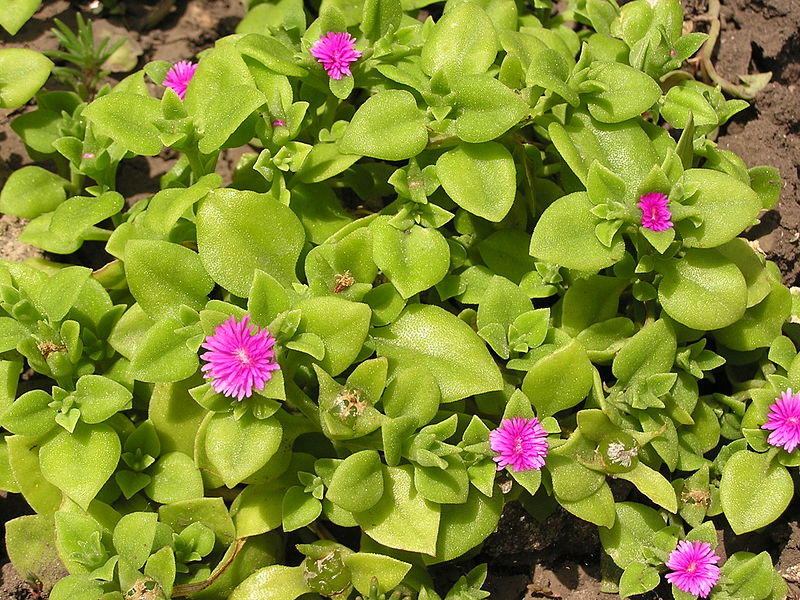


Mesembryanthemum cordifolium is an accepted name according to "The Plant List" database, the primary source for the modern APG taxonomy of flowering plants. Formerly placed in the genus Aptenia and known as A. cordifolia, it was included in Mesembryanthemum in 1997 when the whole genus Aptenia was redused to synonymy.
Perhaps the most common plant seen under this name in gardens is actually Mesembryanthemum 'Red Apple', a hybrid with more vigorous growth, red flowers and bright green leaves, whose parents are M. cordifolium and M. haeckelianum. The true species of M. cordifolium has magenta-purple flowers and more heart-shaped, mid-green, textured leaves.
Native to the Eastern Cape Province of South Africa, this species has become widely known as an ornamental plant. Today it can be found growing in Australia, escaped gardens and naturalized in some parts of California, Oregon and Florida, in the Mediterranean region of the Europe. The plant was recently determined to be invasive in California and was listed as a wildland weed red alert.
This is a succulent, creeping, short-lived, mat-forming perennial herb growing in flat clumps on the ground from a woody base. Plants only rise to about 10 centimetres (3.9 in) tall but prostrate stems reach up to about 60 centimetres (24 in) long. The stems are green and stalk-round. The fleshy, small leaves are opposite, ovate to cordate, about 2.5 centimetres (0.98 in) long and covered with fine papillae. Bright pink to purplish solitary flowers appear in the leaf axils, open during the day but close up at night and remain closed on cloudy days. These colored whorls are not petals, but non-functional modified stamens. Normal stamens are yellow. Flowers bloom primarily from spring to fall. The fruit is a capsule of little more than one centimeter in length with millimeter brown tuberose seeds. There is a variegated form.